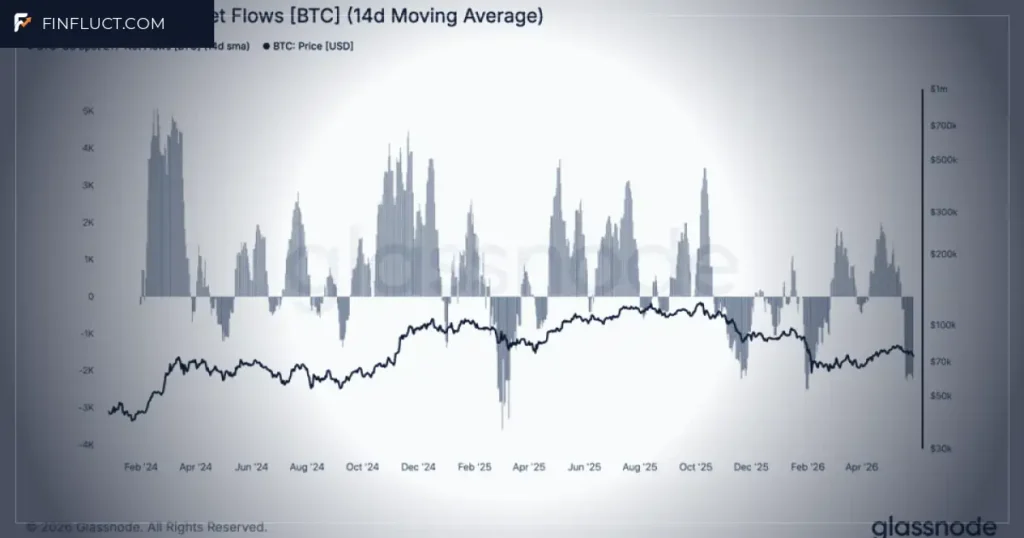
The Unprecedented Exodus from Spot Bitcoin ETFs
U.S. spot Bitcoin (BTC) exchange-traded funds are currently experiencing their longest streak of net outflows since their inception in January 2024. According to SoSoValue data, investors have pulled capital for nine consecutive trading days, marking an unprecedented run for these investment vehicles.
Over this nine-session period, roughly $2.8 billion has been withdrawn from the funds, surpassing any previous stretch of sustained selling pressure. This week alone, U.S. spot Bitcoin ETFs have shed approximately $1.3 billion, extending a run of three consecutive weeks of net outflows. Monthly withdrawals now stand at roughly $2.3 billion.
“The current outflow dynamics from Bitcoin ETFs reflect a temporary shift in investor sentiment, possibly driven by macroeconomic factors and capital reallocation. This isn’t necessarily a sign of a long-term bear trend, but rather a consolidation phase in the digital asset market,” notes a leading crypto market analyst.
Shifting Tides: Bitcoin’s Lag Against Tech Giants
These outflows have coincided with a notable decline in Bitcoin’s value, which has struggled to maintain momentum above key resistance levels. The broader backdrop reveals that since the start of the year, Bitcoin has lagged many of the market’s best-performing assets, particularly AI-related equities, semiconductor, and memory-chip stocks. These sectors have continued to attract capital amid growing enthusiasm around AI infrastructure spending.
Signs of institutional selling have also emerged beneath the surface. BlackRock’s iShares Bitcoin Trust (IBIT) recorded its largest single-day outflow since launch earlier this week, largely driven by a sizeable dark pool transaction. While the precise motivation behind the trade remains unknown, the scale of the redemption suggests some investors may be reallocating capital away from Bitcoin exposure and toward sectors that have recently generated stronger returns.
Historical Precedent: Outflows as Market Bottom Signals?
Sustained ETF outflows have often historically coincided with periods of market stress that later developed into local bottoms. Glassnode data shows that the 14-day moving average of ETF flows tends to trough near significant turning points. Similar patterns emerged during past market corrections, such as the one in early February when Bitcoin briefly fell toward $60,000, and again during other periods of post-all-time-high pullback and local lows.
“Markets are cyclical, and what appears negative in the short term is often a necessary correction. We’ve seen ETF outflows precede recoveries in the past. Institutional investors are constantly re-evaluating their portfolios, and this could simply be a rebalancing phase before the next leg up,” comments an investment strategy expert.
What This Means for Bitcoin’s Price Action
Bitcoin’s failed breakout above $83,000 is looking increasingly like a bear market signal, even as S&P 500 and Nasdaq futures notch gains and approach all-time highs. This divergence highlights the complex current market environment, where traditional assets show strength while digital assets face headwinds.
- Outflow Streak Duration: 9 consecutive days
- Total Outflow During Streak: $2.8 billion
- Current Week’s Outflow: $1.3 billion
- Monthly Outflow: $2.3 billion
Frequently Asked Questions (FAQ)
What is a spot Bitcoin ETF?
A spot Bitcoin ETF is an investment fund that directly holds Bitcoin, allowing investors to gain exposure to BTC’s price without needing to buy and store the cryptocurrency themselves, all through traditional brokerage accounts.
Why are ETF outflows significant?
ETF outflows indicate that investors are selling their shares in the fund, which can signal diminishing interest or a shift in sentiment regarding the underlying asset, in this case, Bitcoin. Significant outflows can put downward pressure on BTC’s price.
Can ETF outflows signal a market bottom?
Historically, periods of sustained ETF outflows have sometimes coincided with phases of market stress that preceded local bottoms. However, this is not a guarantee, and other market factors also influence Bitcoin’s price action.