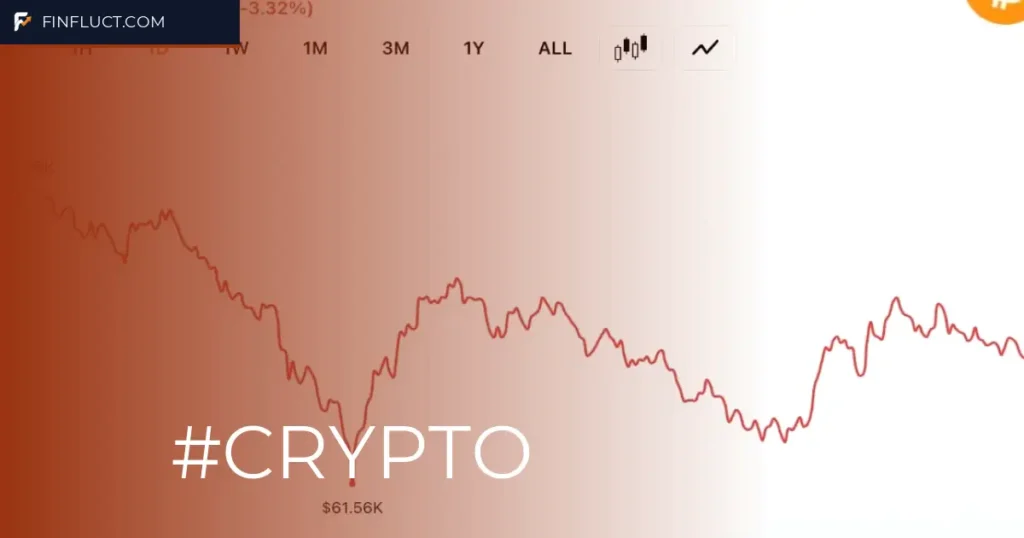
Bitcoin’s Flash Crash and Swift Rebound
The cryptocurrency market recently witnessed significant volatility as BTC experienced a sharp flash crash, briefly dipping to $61,000 before staging a quick recovery. This event underscored the inherent dynamics of digital assets and triggered massive liquidations, impacting investors globally.
After plunging to $61,310 late Wednesday, BTC swiftly reversed its losses, hovering around $64,600 by midnight. However, this momentum couldn’t be sustained, with the price gradually stabilizing just above $62,200. A similar pattern repeated, seeing BTC surge past $64,000 only to stall before testing the $64,500 resistance level.
Market Impact and Massive Liquidations
- Daily Decline: 3.2%
- Weekly Decline: 14%
- Year-to-Date (2026) Decline: Nearly 30%
- Market Cap Dip: To approximately $1.23 trillion
- Total Leveraged Liquidations: $1.73 billion
- BTC Long Liquidations: $636 million
Bitcoin’s market capitalization momentarily plunged to approximately $1.23 trillion following the morning flash crash, before recovering to $1.27 trillion. Since May 29, when its market capitalization was around $1.48 trillion, BTC has shed more than $200 billion, making it one of its worst periods in 2026 so far.
For the third consecutive day, the sell-off across the cryptocurrency market triggered the liquidation of more than $1 billion in leveraged positions. Liquidations on BTC alone topped $803 million, with wiped-out long bets accounting for $636 million of the total. Overall, the market recorded $1.43 billion in liquidated long bets and nearly $307 million in short bets, bringing the total value of leveraged bets wiped out to $1.73 billion.
Diverging Explanations and Expert Insights
While BTC‘s freefall was initially attributed to Middle East political tensions and MicroStrategy‘s sale of 32 bitcoins, views diverge as to why it plunged.
Michael Saylor, Executive Chairman of MicroStrategy, weighed into the debate by attributing the net outflows from spot exchange-traded funds (ETFs) to capital rotation rather than capital impairment.
Grayscale Research noted that while MicroStrategy‘s disclosure of the sale weighed heavily on investor sentiment, the actual amount sold is fundamentally insignificant compared to the firm’s broader balance sheet. According to Grayscale, the market’s aggressive reaction highlights a shift toward a compressed volatility regime where sharp, narrative-driven moves are frequently triggered by institutional headlines rather than structural changes.
Lacie Zhang, a research analyst at Bitget Wallet, commented: “BTC tested the low-$60Ks, cleared a $1.8 billion liquidation wave, including more than $1.5 billion in long positions, and has already bounced toward $63K. Funding rates have flipped deeply negative, open interest has reset sharply, and Fear & Greed is at 12. That is a market that has done significant technical work in a short window.”
Zhang also noted that while a retest of $55,000 to $57,000 remains possible if outflows persist, “crypto may already be closer to clearing this episode than equity markets are.”
Nicolai Sondergaard, a research analyst at Nansen, argued that market participants are using the move off $61,000 to reduce exposure rather than add to it.
FAQ: Bitcoin and Market Volatility
- What caused the recent Bitcoin flash crash?
The crash was initially linked to geopolitical tensions and MicroStrategy‘s BTC sale. However, experts also point to overall market volatility and the pricing in of macro stress.
- What are leveraged liquidations?
Leveraged liquidations occur when a trader’s position is forcibly closed due to insufficient funds to maintain the margin. The recent crash triggered $1.73 billion in such liquidations.
- What is the current state of the Bitcoin market?
Despite recovering from the flash crash, BTC remains significantly down daily and weekly. Analysts suggest the market has done considerable ‘technical work,’ but potential for further fluctuations remains.