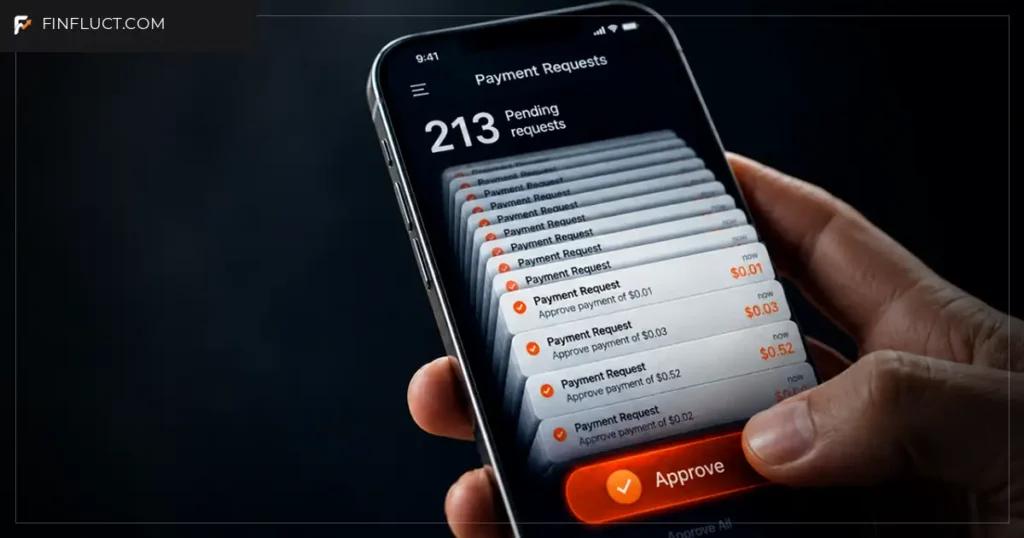
Key Insights on Agentic Infrastructure:
- The x402 protocol transaction volume dropped 77% from its November 2025 peak, but monthly transaction counts rebounded to 2.89 million by May 2026.
- The average transaction size is now just $0.52, signaling a massive shift toward high-frequency, low-value machine-to-machine payments.
- Manual wallet confirmations create up to 12,000 hours of user friction monthly, making automated authorization frameworks the new industry battleground.
The Rise of Sub-Dollar Machine Payments
On-chain data from Artemis reveals that crypto-native agentic payments are settling into millions of tiny transactions. This represents the exact type of micro-scale automation that decentralized networks were built to support. Although the overall dollar volume of the x402 protocol collapsed from its November 2025 peak of $5.15 million to $1.19 million by May 2026, the underlying transaction count tells a far more resilient story.
Monthly transactions fell only 41% from their December peak before rebounding to 2.89 million in May 2026—a 12.5x increase from the February trough. With an average transaction size of just $0.52, AI agents are actively paying for APIs, data, and compute over HTTP at sub-dollar amounts, relying entirely on automated execution to function.
The Friction Economy in Numbers:
- Average Transaction Size: $0.52
- Wallet Confirmation Time: 5 to 15 seconds
- Monthly User Friction: 4,000 to 12,000 hours
- Friction Cost per Click: $0.03 to $0.10 (at a $25/hour time value)
The Economic Absurdity of Manual Approvals
A conservative 5-to-15-second wallet confirmation for each of those 2.89 million monthly x402 transactions generates between 4,000 and 12,000 user-hours of approval friction in a single month.
“At a $25/hour time value, each manual confirmation costs between $0.03 and $0.10. This is highly material for a $0.52 transaction, and economically absurd for a $0.01 API call. When the friction cost exceeds the transaction value, the system breaks down,” industry experts warn.
This fundamental friction explains why every major player building machine-to-machine payment infrastructure is now focusing heavily on delegated authorization frameworks.
The Authorization War: AP2, Verifiable Intent, and MPP
In April 2026, Google donated its AP2 framework to the FIDO Alliance. Developed as an authorization standard for delegated AI tasks, AP2 uses cryptographically signed “mandates”—pre-authorized rules defining what an agent can do, under what conditions, and within what budget limits.
Other financial giants are rapidly deploying competing solutions:
- Mastercard’s Verifiable Intent: Creates a tamper-resistant audit trail linking what the user authorized to what the agent executed.
- Stripe & Tempo’s MPP: The Machine Payments Protocol (MPP) requires only two on-chain transactions (one to open, one to settle), allowing agents to execute high-frequency payments without paying gas fees per request. Stripe’s documentation supports pay-per-use models starting at 0.01 USDC.
- Visa’s Intelligent Commerce Connect: A pilot program with AWS and Highnote designed to bring tokenization and spend controls to autonomous agents.
The Base MCP Disconnect
The launch of Base MCP on May 26 exposed the current limitations of on-chain delegation. While an agent on Base can check balances, swap tokens, and propose x402 payments, every write action still requires manual user approval via Base Account. For security, this gate is essential; for a $0.10 recurring API payment, it is an insurmountable wall.
The Road Ahead: $1 Trillion or Project Cancellations?
If delegation frameworks mature, McKinsey estimates that agentic commerce could orchestrate up to $1 trillion in US B2C retail revenue and up to $5 trillion globally by 2030. Under this bull case, x402 transactions could scale to 10–30 million monthly.
Conversely, Gartner presents a sober bear case, predicting that over 40% of agentic AI projects will be canceled by the end of 2027 due to high costs, unclear value, and weak risk controls. If wallets default to human-in-the-loop requirements for liability reasons, transaction counts may remain stagnant in the 1-to-3 million range.
Frequently Asked Questions (FAQ)
What are agentic payments?
Agentic payments are automated, machine-to-machine transactions executed by AI agents to pay for digital services like APIs, data, and cloud compute without human intervention.
Why is manual wallet confirmation a problem for AI agents?
For micropayments (often under $0.50), the time and cognitive cost for a human to manually approve each transaction exceeds the economic value of the transaction itself.
How does Google’s AP2 framework help?
AP2 allows users to issue cryptographically signed “mandates” that set pre-approved spending limits and rules, enabling AI agents to transact autonomously within safe boundaries.