Key Takeaways
- Bitcoin has slipped below the crucial $75,000 psychological support level.
- US spot Bitcoin ETFs shed roughly $2.26 billion over a two-week period.
- Dealers face over $8 billion in negative gamma exposure near the $75,000 strike.
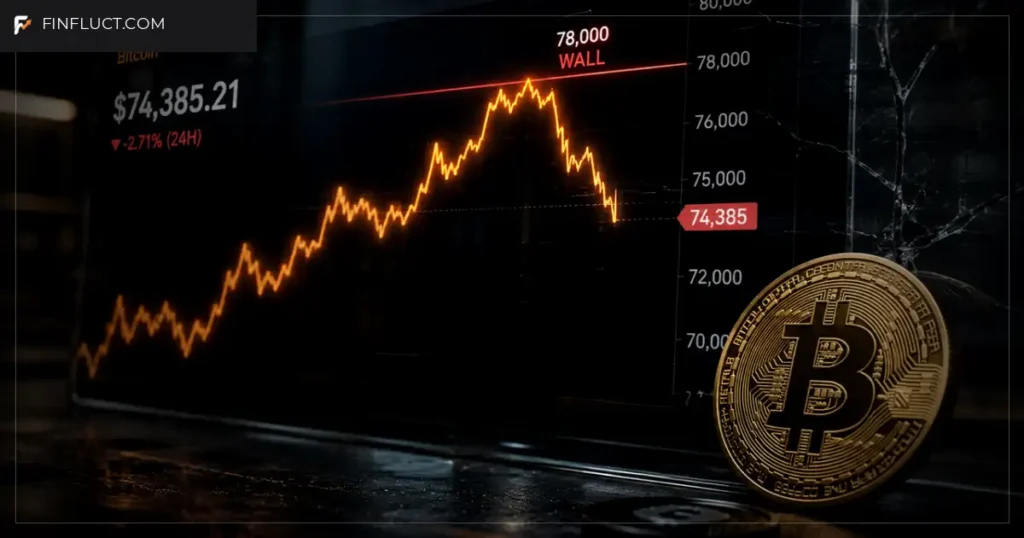
The cryptocurrency market is experiencing a notable cooling period as macroeconomic headwinds and derivatives positioning put the brakes on the spring rally. Bitcoin (BTC) has dipped below $75,000 for the second time in May, touching an intraday low near $72,600 during Asian trading hours.
The $78,000 Resistance Bottleneck
According to the latest on-chain report from Glassnode, the price band between $75,000 and $78,000 has transformed into a major bottleneck. This specific cluster sits directly beneath the Short-Term Holder Cost Basis and the True Market Mean, both of which are currently converging near the $78,000 mark.
“The convergence of the Short-Term Holder Cost Basis and the True Market Mean near $78,000 has created a formidable psychological and technical barrier. Without a decisive spot-driven push, recent buyers risk turning from a support floor into a source of overhead resistance.”
Trading below this threshold leaves recent buyers—the most price-sensitive cohort in the market—holding positions at breakeven or slightly underwater. If the price remains depressed, this group could easily transition from a supportive holding base into a source of active sell-side pressure.
Key Market Metrics
- Bitcoin Market Dominance: 59.74%
- Total Crypto Market Cap: $2.46T
- Realized Profit/Loss Ratio: 1.56
The Options Overhang and Negative Gamma
The technical picture is further complicated by concentrated positioning in the derivatives market. Options dealers have established heavy exposure around the $75,000–$76,000 strikes for the end-of-month expiry. Glassnode highlights that there is more than $8 billion of negative gamma concentrated near $75,000.
This negative gamma environment forces market makers to sell into falling prices and buy into rising prices to maintain delta-neutral portfolios. Consequently, this mechanical hedging compresses the trading range and makes spot prices highly reactive to minor order flows near the key strike price.
ETF Outflows and Macro Pressures
While institutional demand drove the early yearly rally, that momentum has temporarily reversed. US spot Bitcoin ETFs experienced significant outflows, shedding approximately $2.26 billion over two weeks. Daily data from Farside Investors showed major single-day outflows, including $648.6 million on May 18 and $333.6 million on May 26.
This capital flight aligns with broader macroeconomic pressures. Rising long-term borrowing costs in the US, a firm dollar, and geopolitical uncertainties have prompted investors to de-risk, dragging Bitcoin down alongside traditional equity indexes.
Frequently Asked Questions (FAQ)
Q: Why is the $78,000 level critical for Bitcoin’s recovery?
A: This level represents the convergence of the Short-Term Holder Cost Basis and the True Market Mean. Reclaiming it is essential to validate a transition back into a sustained bull market.
Q: How does negative gamma affect Bitcoin’s price volatility?
A: Negative gamma forces options dealers to sell as the price drops and buy as it rises. This amplifies downward or upward momentum, making the spot price highly sensitive to small trades.
Q: What is the bearish target if the $75,000 level fails to hold?
A: If spot demand does not return after the options expiry, Bitcoin could drift lower, shifting the market focus back toward the major support floor at $60,000.