Cardano’s Governance Vetoes 2026 Summit, Raising Questions on Execution
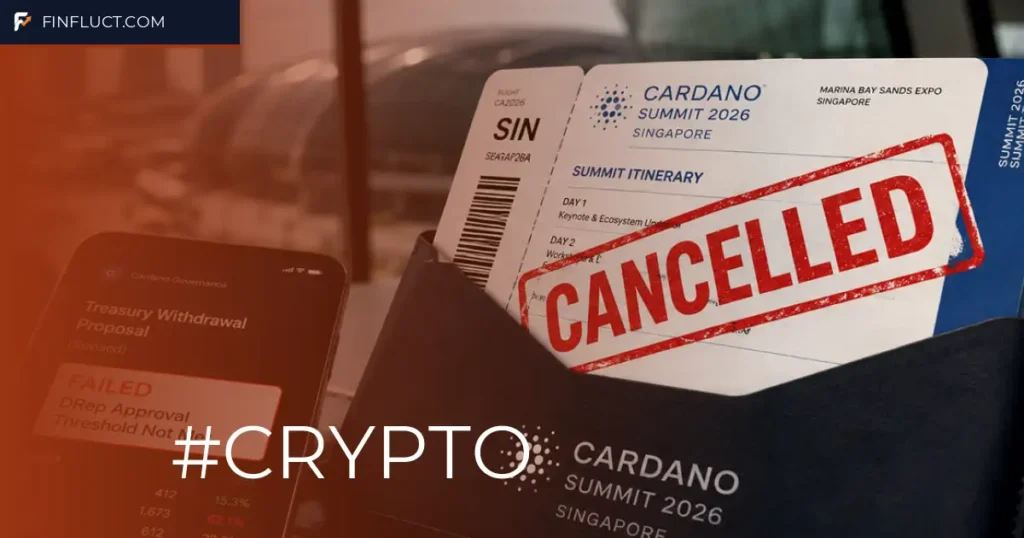
The highly anticipated Cardano Summit 2026 in Singapore will not proceed as planned. This decision stems directly from the network’s treasury governance process, which failed to approve the necessary funding. The cancellation highlights the unique dynamics of decentralized autonomous organizations (DAOs) and the power token holders wield over operational decisions.
“The Cardano Summit incident is a stark illustration of how decentralized governance can be both a strength and a bottleneck. It provides an unprecedented level of accountability but can also lead to operational delays or even the outright cancellation of crucial initiatives,” comments a leading FinTech analyst.
The Unfolding Story: Cardano‘s Singapore Summit Halted
The official event page now confirms the Summit, originally slated for October 5-6, will not take place. The Cardano Foundation, the entity behind the proposal, stated that treasury-funded initiatives are subject to community vote, and the community decided not to proceed with the proposal.
A revised 7.8 million ADA funding request from the Cardano Foundation, already trimmed from an earlier bundled proposal, expired below the Delegated Representative (DRep) threshold. Interestingly, EMURGO‘s separate TOKEN2049 sponsorship in Singapore *did* pass, indicating a selective approach by DReps.
- Funding Requested: 7.8 million ADA
- Summit Budget: $1.95 million (based on ADA at $0.25)
- Target Attendees: 1,200
- DRep Support: 64.61% ‘yes’ votes
- Required Threshold: 67%
Anatomy of a Veto: How ADA Holders Shaped the Outcome
The mechanics of Cardano‘s voting system require both Constitutional Committee and DRep approval for treasury withdrawals, with the DRep approval threshold set at 0.67 (67%). Despite the proposal garnering 64.61% ‘yes’ support, it fell short of this critical threshold, leading to its rejection.
“This situation demonstrates that a simple majority vote doesn’t always guarantee success in threshold-based governance systems. It underscores the importance of active participation and coordination to achieve the consensus needed for major initiatives,” explains a blockchain governance expert.
The Summit proposal aimed for a two-day event featuring an ‘Ecosystem Day’ for builders and an ‘Industry Day’ for enterprise and regulatory audiences. The cancellation directly impacts these objectives, including the goal of attracting 250 marketing-qualified leads and facilitating 50 strategic meetings.
Dual Edges of Decentralization: Discipline vs. Velocity
The Summit’s cancellation carries a dual significance for the Cardano ecosystem. On one side, it strengthens Cardano‘s claim that its on-chain governance has real teeth. The Cardano Foundation, a central institution, was compelled to accept the community’s decision, showcasing the system’s effectiveness.
On the other side, a governance system that can stop spending must also prove it can fund high-value work on usable timelines. If major initiatives repeatedly miss thresholds, Cardano might gain budget discipline but lose execution speed. This could manifest as calendar uncertainty, weaker partner confidence, and fewer clear opportunities to leverage large industry gatherings.
Market Implications and Future Outlook for ADA
Against this backdrop, ADA traded near $0.23, down slightly over 2% in 24 hours, with a market capitalization around $8.4 billion. The vote illustrates how treasury scrutiny can shape the ecosystem’s public calendar as well as its balance sheet.
Future treasury proposals may face pressure to demonstrate tighter budgets, cleaner separation from adjacent sponsorships, and stronger evidence that spending creates measurable ecosystem value. The Summit cancellation makes decentralization operational, allowing DReps to publicly restrain core institutions.
Frequently Asked Questions (FAQ)
- Why was the Cardano Summit 2026 cancelled?
The Summit was cancelled because its 7.8 million ADA treasury funding proposal failed to meet the required 67% approval threshold from Delegated Representatives (DReps), despite receiving 64.61% ‘yes’ votes. - What are DReps in the Cardano ecosystem?
DReps, or Delegated Representatives, are key participants in Cardano‘s governance system. They vote on proposals affecting the network’s development and funding, representing the interests of ADA holders. - How does the Summit cancellation impact Cardano‘s reputation?
The cancellation demonstrates the strength of Cardano‘s decentralized governance, showing the community can restrain even central institutions. However, it also raises concerns about execution speed and the ability to fund major initiatives efficiently, potentially impacting partner confidence and institutional engagement.