Solana Eyes Major Fee Burning Increase
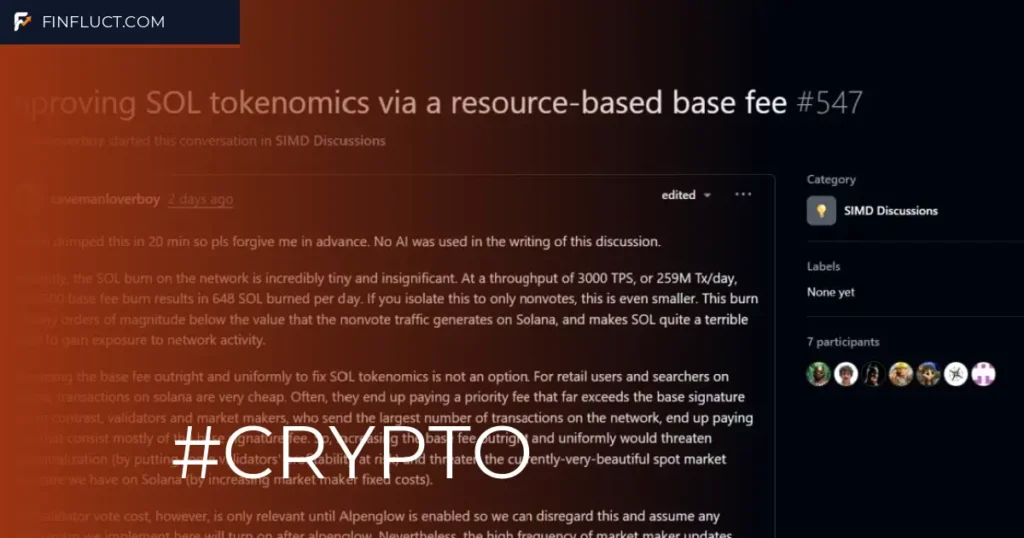
The Solana community is buzzing with discussion over a groundbreaking proposal that could fundamentally reshape the tokenomics of SOL, the network’s native asset. Known as Solana Improvement Document 547 (SIMD-547), the initiative, introduced by pseudonymous developer cavemanloverboy, seeks to dramatically increase the amount of SOL burned by implementing a new base fee for every transaction.
This move is designed to potentially make Solana’s network issuance deflationary during periods of intense activity, which some experts believe would significantly enhance SOL‘s value as an asset for gaining exposure to network activity.
How Fees and Burning Could Change
Under the proposed SIMD-547 scheme, the new base fee would vary depending on the transaction’s nature. Market makers and users who opt for priority rates to execute their movements faster would experience less impact. However, users paying lower fees could see their costs surge by up to 600% in certain scenarios.
Cavemanloverboy argues that the current level of fee burning is “incredibly tiny and insignificant.” He highlighted that only $1 million in SOL was burned in May, even as Solana dapps generated over $90 million in revenue. If this new proposal gains approval, that monthly burn figure could escalate to between $3.6 and $36 million.
- Current daily SOL burning: 648 SOL
- Projected daily SOL burning (with 25x activity increase): 10,800 – 64,800 SOL
Divergent Views Within the Solana Ecosystem
The proposal has garnered support from Solana co-founder Anatoly Yakovenko, lending it considerable weight. Yet, not everyone in the Solana ecosystem shares this optimism.
“We need to be able to support 100k+ tps that are a rounding error to users of the network, otherwise we cannot compete with tradfi databases or even other networks,” stated Michael Hubbard, CEO of SOL Strategies.
Michael Hubbard, CEO of SOL Strategies—a publicly traded Canadian company holding over $40 million in SOL and charting a course to the Nasdaq—has voiced concerns that SIMD-547 could hinder the network’s ability to support new use cases. He advocates for even cheaper transaction fees, emphasizing that “agentic activity is increasing” and “larger players and institutions aren’t fully operating on-chain yet.”
The Future of SOL Tokenomics
The debate surrounding SIMD-547 underscores the tension between pursuing a deflationary tokenomics model and the imperative to maintain low fees for mass adoption and blockchain scalability. The outcome of this proposal will have significant implications for Solana’s long-term strategy and its competitiveness in the broader market.
Frequently Asked Questions (FAQ)
What is SIMD-547?
SIMD-547 (Solana Improvement Document 547) is a proposal introduced by developer cavemanloverboy to increase the burning of SOL tokens by introducing a new base fee for transactions on the Solana network.
What is the primary goal of SIMD-547?
Its main goal is to improve SOL’s tokenomics, reduce current inflation levels, and potentially make Solana’s network issuance deflationary during periods of high activity, thereby enhancing SOL’s value as an asset.
Why are some community members critical of the proposal?
Critics, such as Michael Hubbard of SOL Strategies, worry that increased fees could hamper the network’s ability to support new use cases and prevent Solana from competing effectively with traditional finance systems and other blockchains that offer lower or zero transaction costs.