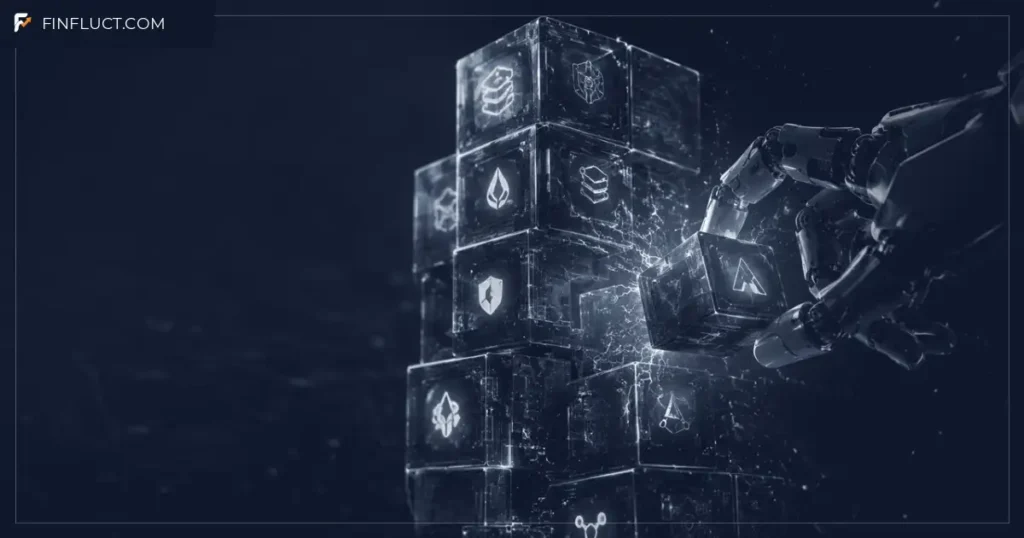
The decentralized finance (DeFi) sector is facing an existential challenge. The rapid evolution of autonomous AI agents capable of identifying code vulnerabilities in seconds is shifting the balance of power heavily in favor of attackers.
The New Threat: Why AI Changes the Rules of DeFi Security
A warning from one of decentralized finance’s early security figures has turned a difficult stretch of hacks into a broader test of how the industry can defend itself against artificial intelligence. Manuel Aráoz, co-founder and former chief technology officer of OpenZeppelin, advised investors to exit DeFi positions entirely, including exposure to established lending protocols such as AAVE, MakerDAO (MKR), and Compound (COMP).
According to Aráoz, autonomous AI coding agents have widened the gap between attackers and defenders by making it easier to find vulnerabilities at scale.
“Coding agents are superhuman at finding vulnerabilities, and smart contract security is too asymmetric. Defenders need to fix every bug while attackers need just one exploit to steal funds.”
DeFi Security in Numbers
- Total Lost to Exploits (Past Year): $1.1 Billion
- April Losses: $635 Million (across 28 reported hacks)
- DeFi TVL Drop: From $172 Billion to $148 Billion
Weapons of Mass Bug Discovery
Aráoz’s warning is grounded in the fact that artificial intelligence fundamentally lowers the cost and effort required to map smart contract vulnerabilities. Recent research from venture capital firm a16z validates this accelerating offensive capability, noting that AI agents have consistently identified core vulnerabilities in historical DeFi exploits.
Even when agents failed to execute an exploit autonomously, they often reached the stage that gives human attackers a perfect starting point. The threat is so tangible that Anthropic has restricted public access to its unreleased Claude Mythos model precisely because of its capacity to autonomously discover and weaponize software flaws.
The Counter-Argument: Operational Lapses vs. Smart Contract Bugs
However, concerns about AI have drawn pushback from founders and security firms who argue that DeFi has become more resilient than in earlier cycles. Blockchain security firm OpenZeppelin argued that many recent security incidents stemmed from operational failures instead of flaws in audited contract code.
According to the firm, most large losses in recent months have involved stolen private keys, bridge spoofing, social engineering, and access control issues. A prime example is Drift Protocol’s $285 million loss, which was tied to a six-month social engineering campaign from North Korea’s Lazarus Group.
Aave founder Stani Kulechov made a similar argument:
“DeFi infrastructure today benefits from better risk engines, lending market structures, formal verification, audits, bug bounties, cap management, oracle improvements, automated monitoring, and circuit breakers. Much of the remaining attack surface involves Web2-style operational lapses.”
The AI-vs-AI Security Era
Instead of pulling away from open-source development, major protocols are leaning into AI tools on the defensive side. Deddy Lavid, chief executive officer of Cyvers, stated that the industry is rapidly moving toward an AI-versus-AI security environment.
In this field, crypto developers are using the same AI tools to find and eradicate bugs before attackers do. OpenZeppelin recently introduced tooling designed to help AI agents generate smart contracts using current, audited security libraries. Similarly, Uniswap has launched an AI-integrated developer platform to make secure deployments easier from the start.
Mitigating the Blast Radius
To survive this shift, static, point-in-time audits are no longer enough. Experts suggest that protocols must adopt:
- Continuous monitoring and live transaction simulation;
- Automated circuit breakers to pause activity when suspicious behavior appears;
- Blast radius reduction, ensuring a single compromised key or configuration error cannot drain an entire liquidity pool.
Frequently Asked Questions (FAQ)
Is it really necessary to exit all DeFi positions?
Most industry experts believe a total exit is unnecessary. Instead, users should avoid highly complex, new, or exotic protocols and focus on older, battle-tested systems with simple designs.
How does AI help attackers in DeFi?
AI agents can scan open-source smart contracts at near-zero cost, instantly identifying logical flaws, edge cases, and integration vulnerabilities that human developers might miss.
What does “blast radius” mean in Web3 security?
It refers to architectural limits designed to contain damage. If one part of a protocol (or a single private key) is compromised, the system is structured so that the loss is isolated and cannot affect the rest of the funds.