For years, US traders have been locked out of the most liquid sector of the digital asset market: perpetual swaps. This regulatory breakthrough turns the theoretical debate about onshoring crypto derivatives into a live, regulated market-structure experiment.
Two Distinct Regulatory Paths
The CFTC has introduced two parallel frameworks to bring perpetual liquidity back to US shores. The first is a direct exchange listing under a formal Commission order, while the second relies on a conditional staff-level routing mechanism.
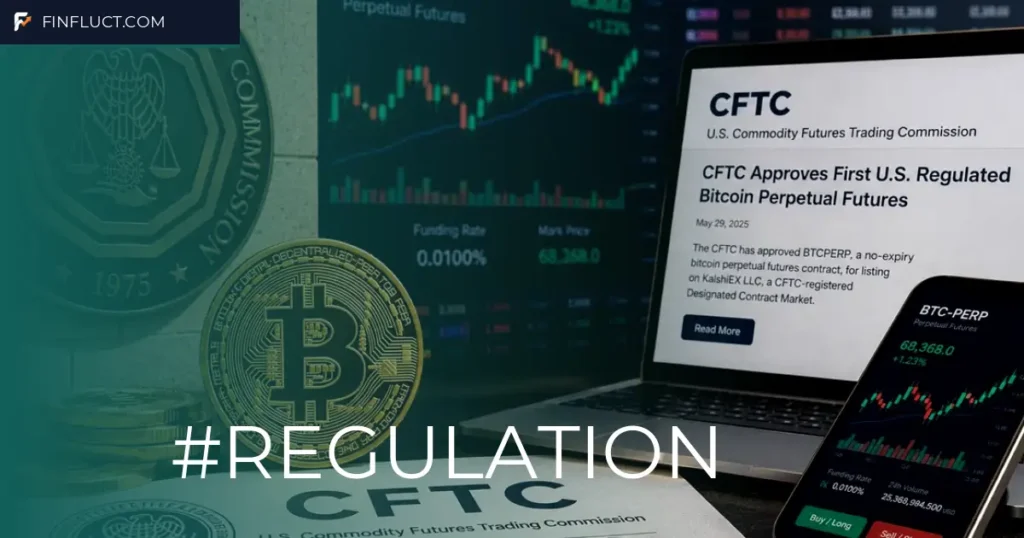
- The Kalshi Path: A direct, CFTC-approved domestic listing of BTCPERP as a registered futures contract.
- The Coinbase Path: A staff-level no-action position allowing Coinbase’s registered Futures Commission Merchant (FCM) to route institutional orders to foreign board of trade Deribit.
“This dual-track approach shows the CFTC’s willingness to adapt legacy rules to 24/7 crypto markets. However, the real test will be whether these regulated channels can offer enough leverage and liquidity to compete with offshore giants.”
The Scale of the Global Derivatives Market:
- Global crypto volume consisting of derivatives: ~80%
- Deribit’s mid-2025 monthly trading volume: $185B
- Deribit’s platform open interest: $60B
Understanding Kalshi’s BTCPERP Contract
Kalshi’s contract is a cash-settled derivative tracking the US dollar spot price of Bitcoin via the CF Benchmarks Bitcoin Real Time Index. Trading in units of one ten-thousandth of a BTC, it operates 24 hours a day, seven days a week.
Because perpetuals have no fixed expiry, they rely on a continuous funding rate mechanism to align the contract price with the spot market. If the perp price trades above spot, long positions pay shorts; if it trades below, shorts pay longs.
Coinbase’s Gateway to Global Liquidity
Coinbase’s solution is highly technical. Under the CFTC’s Market Participants Division letter, Coinbase Financial Markets can route US customer orders through its affiliate, Coinbase Bermuda, directly to Deribit. The relief also covers complex margin treatments, allowing customer-owned digital assets and stablecoins to be posted as collateral under strict operational controls.
Frequently Asked Questions (FAQ)
What is a perpetual future?
A perpetual future (or perp) is a financial derivative that mimics a traditional futures contract but lacks an expiration date, allowing traders to hold positions indefinitely.
Why is this CFTC decision significant?
It represents the first time the CFTC has formally approved a true, no-expiry cryptocurrency perpetual contract for US trading, potentially bringing billions of dollars in trading volume back under US regulatory oversight.
Who can trade these new products?
Kalshi plans to offer its BTCPERP to retail and institutional investors alike, while Coinbase’s route to Deribit will initially focus on institutional onboarding before expanding access.